Running in thunderstorms: when to stop and shelter
Check the storm outlook and shelter access before leaving. If thunder or lightning appears, stop, get inside and reassess after the last thunder.
By WeatherToRun, updated
Get hourly running scores and clothing suggestions on iPhone. Free core guidance. No account needed.
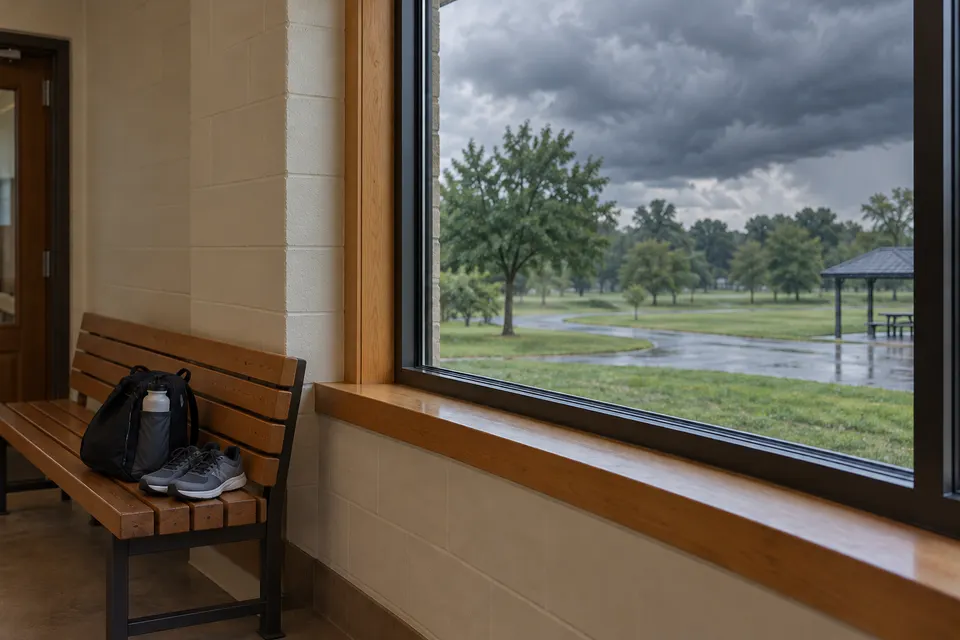
If you hear thunder while running, stop and get to suitable shelter immediately. A useful plan for running in thunderstorms starts before you leave, with somewhere you can actually enter and an indoor alternative if the weather changes.
The difficult part is often the route. A familiar park loop may take you past plenty of covered benches while offering no substantial building you can enter. Work out that gap before choosing your starting hour or committing to a long out-and-back.
Check the storm outlook before choosing the route
Read your local forecast text and current official watches and warnings, then consider the whole outing, including travel and any time spent outside afterward. If thunderstorms threaten during that window, postponing the run or choosing an indoor session may be the practical decision before you put your shoes on.
The NOAA National Severe Storms Laboratory distinguishes a severe-thunderstorm watch, when conditions favor development, from a warning, which calls for immediate protective action. Thunderstorms also produce lightning when they do not meet the severe classification. Do not wait for a severe warning before responding to thunder or lightning.
Storm planning matters outside summer. For example, NWS Mobile/Pensacola identifies November and December as a secondary severe-weather season in Alabama, Mississippi and northwest Florida. That is regional context, rather than a forecast for your next run or a nationwide autumn pattern. Check the outlook for the place you will actually run.
A rain percentage cannot identify a lightning-free route. It describes precipitation likelihood for a stated place and period, rather than the exact minutes when a storm might affect your path. Our rain guide explains chance, amount and timing in more detail. Use that information alongside the storm outlook, with a way to receive current local warnings as conditions develop.
Identify shelter you can actually enter
Before departure, name the building or vehicle you would use, check access and think about the farthest point on the route. A closed visitor center, locked restroom or building beyond a closed gate cannot serve as your shelter plan. Avoid assuming that a shorter loop solves the problem if storms are already nearby.
NWS outdoor-sports guidance recommends a substantial building with wiring or plumbing. If a building is unavailable, an enclosed, hard-topped metal vehicle with its windows shut can provide lightning protection. Check that you can reach and enter it, including having the keys with you.
For a route check, separate these options:
- Substantial building: confirm that it is open and that you can get inside. Once sheltered, stay away from windows, plumbing and plugged-in equipment.
- Enclosed hard-topped vehicle: an alternative for lightning when a substantial building is unavailable. An open vehicle or convertible does not meet this description.
- Picnic pavilion, dugout, tent or isolated tree: these do not provide lightning protection. Staying dry underneath one does not resolve the hazard.
The NWS outdoor-situations guide explains why open rain shelters are unsuitable. A vehicle is also not equivalent protection against every storm hazard. If damaging wind, hail or another severe-weather warning threatens, follow the specific official instructions and seek a sturdy building promptly.
Consider a hypothetical 5-mile (8 km) park run near Pensacola. The route's only cover is an open picnic pavilion, and thunderstorms are possible during your available time. Moving the session indoors before departure is a workable plan. Running a smaller loop around the same pavilion would still leave the shelter problem unresolved.
Act promptly if thunder or lightning appears
Stop the outdoor session and move toward suitable shelter. Leave time to get inside as threatening weather develops; do not wait for rain to begin, finish an interval or take an extra loop to complete your planned distance. A dry patch overhead does not establish that the storm is far enough away.
If you are caught away from a building or vehicle, keep seeking shelter. The CDC's lightning guidance advises avoiding exposed high ground, isolated trees, water and conductive objects. Those actions reduce exposure while you seek protection; they cannot make an outdoor location safe during a thunderstorm.
Avoid settling beneath a tree or against a metal fence to wait. The NWS lightning-myths page rejects crouching as a safe substitute for shelter and advises against lying flat. Rubber running shoes do not provide lightning protection. Removing a watch or phone also does not create protection or justify delaying shelter.
For a group run, agree on the decision before starting: where everyone will shelter and how the outdoor session will end if conditions change. Follow an organized event's weather instructions rather than treating a race or group start as permission to continue.
If someone is struck, call 911 in the US, give the location and follow the dispatcher's instructions. A lightning victim does not retain electrical charge. Follow emergency guidance for assistance and CPR or an AED as directed or trained, while accounting for the continuing storm hazard.
Wait from the last thunder, then reassess
NWS advises waiting at least 30 minutes after the last thunder before resuming outdoor activity. Each new thunder restarts the wait. Count from that sound, rather than from when rain stops, a radar color changes or a weather score improves.
For example, thunder at 5:10 p.m. means the lightning-related wait extends to at least 5:40 p.m. If you hear thunder again at 5:25 p.m., it extends to at least 5:55 p.m. These are illustrative clock times, not a forecast or an automatic clearance to restart.
After the wait, check current warnings and the route again. Floodwater, damaged trees, downed power lines and closures can make the original plan unusable even after the lightning wait has passed. Follow local closure instructions and choose another session if access remains uncertain.
NWS flood guidance advises turning away from flooded areas. Do not run or walk into water to test its depth or the surface underneath. Keep ordinary wind and gust planning separate from a route affected by storm damage.
Ending the outing is a complete decision. You do not need to squeeze the original mileage into the time remaining before darkness, closing time or another storm window.
Use WeatherToRun to compare your next workable window
Once you have a practical route and the official outlook supports reconsidering an outdoor session, compare hours you can actually use. WeatherToRun's hourly forecast and running score can help you inspect conditions and clothing suggestions. They cannot certify lightning safety along your route or replace official warnings, hearing thunder and checking actual shelter access.
Use this short planning sequence:
- Choose the location where you intend to run and compare available future hours.
- Check conditions through the likely finish, rather than choosing only the best-looking start hour.
- Recheck local official forecasts and warnings before leaving, and keep your shelter and indoor alternatives available.
The first-run tutorial shows the actual iPhone controls. For a broader weather comparison, use how to choose the best time to run. You can explore the New York forecast, choose your own location, or see WeatherToRun for iPhone to plan the next outing.
WeatherToRun for iPhone
Compare hourly running scores, find a better time, and get clothing suggestions on your iPhone. Core forecasts and gear guidance are free. Extra planning and widgets are available with Plus.
Free to download. No account or ads.