What to wear running by temperature
Start with the feels-like temperature, choose a removable layer, and adjust for wind and rain.
By WeatherToRun, updated
Get hourly running scores and clothing suggestions on iPhone. Free core guidance. No account needed.
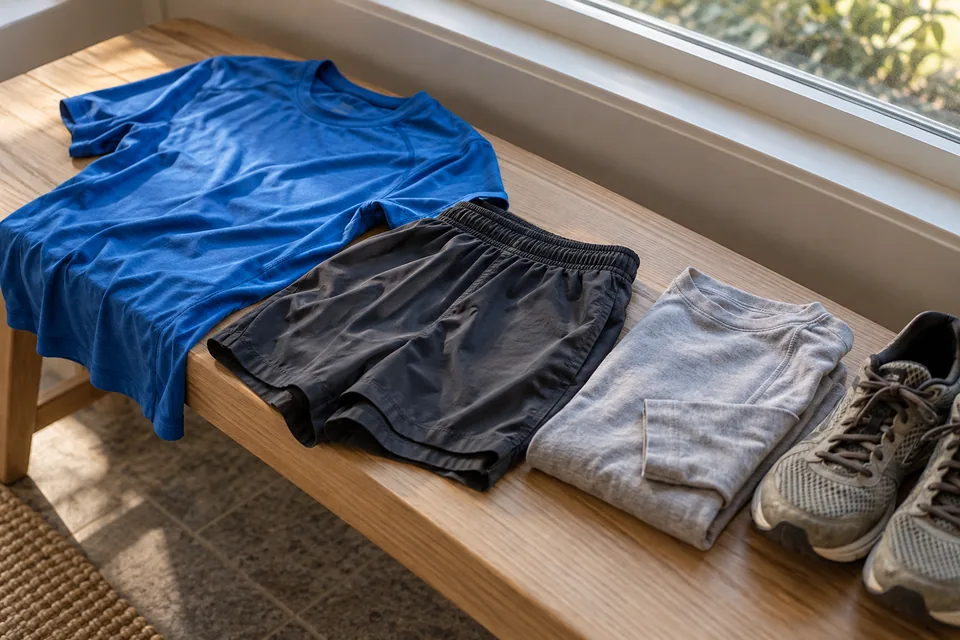
Same temperature, different clothing
These are hypothetical conditions, calculated with WeatherToRun’s current engine. They are examples, not today’s forecast.
Both hours feel like 55°F / 13°C, with 3 mph / 5 km/h wind and UV 2. The default layering preference stays the same; rain changes the suggested kit.
| Conditions | Suggested clothing |
|---|---|
| Dry No forecast rain | Long Sleeve, Shorts, Light Socks |
| Rainy 60% chance; 1.5 mm / 0.06 in for the hour; rain condition | Rain Jacket, Long Sleeve, Half Tights, Warm Socks |
Your layering preference changes that dry example too. Fewer layers gives t-shirt, shorts, light socks; more layers gives long sleeve, half tights, light socks. The forecast temperature itself stays the same.
The dry example uses 60% relative humidity; the rainy example uses 85%. Both are daylight examples. Rain chance and hourly amount describe different things; neither tells you how long rain will last on your route.
The right running outfit starts with the conditions for the hour you will be outside, not the day's highest temperature. Use the feels-like temperature as a starting point, then look at wind, rain and the length of your run. Your own tendency to run hot or cold matters too.
Running clothing by temperature
These are starting points for an easy run in mostly dry conditions. The bands are rounded equivalents, so choose the neighbouring outfit when you are close to a boundary. They are not medical thresholds.
- 60°F / 16°C and warmer: a light shirt and shorts. Choose coverage and sun protection for the route and UV forecast.
- 50–59°F / 10–15°C: a light long-sleeve top with shorts or tights, depending on your preference. Choose a layer you can remove rather than committing to a thick jacket.
- 40–49°F / 4–9°C: a long-sleeve top and leg coverage. Light gloves may help at the cooler end. Add a light outer layer when exposure or rain warrants it.
- Below 40°F / 4°C: start with a base layer, adjustable outer protection and warmer leg coverage. Consider gloves and ear coverage, then check wind chill and footing before deciding to go.
For example, at 52°F / 11°C on a sheltered, dry loop, a light long sleeve may give you enough flexibility. At the same temperature on an exposed wet route, protection from rain and wind becomes a separate clothing decision. A bulky insulating jacket is not automatically the answer to every uncomfortable forecast.
Adjust for wind and rain
Wind exposure changes the balance. A thin wind layer can be useful on an open waterfront even when the temperature would usually call for a light top. Choose a layer that lets you release heat as your effort rises. See the wind guide for gusts and route planning.
Rain deserves its own check. A 60% rain chance does not mean it will rain for 60% of your run, or tell you how hard it will rain. The National Weather Service's probability explanation distinguishes the chance of precipitation from its intensity. Inspect the hourly rain amount and weather conditions as well as probability.
The worked comparison above keeps the feels-like temperature fixed so you can see the clothing change caused by rain. The hourly amount is a separate forecast input, as the Open-Meteo weather documentation explains. Use the suggestion as a kit check, then consider whether the route gives you shelter or an easy way home.
For a cool, wet run, think about both keeping moving and getting home. Clothing that feels acceptable during the run can become uncomfortable when you stop. Have dry clothes available if you will wait outdoors afterwards. The CDC's cold-weather guidance explains that wet conditions can contribute to hypothermia even outside extreme cold.
Match the outfit to the session
A short easy loop and a long run ending far from home need different margins. Use the forecast at your finishing hour, especially if temperature falls or wind increases. For a session with pauses, consider how you will stay comfortable during those pauses rather than dressing only for continuous movement.
Build a small personal record: note the feels-like temperature, conditions, outfit and whether you felt too warm or too cold. After a few runs, change one item at a time. This is more useful than treating someone else's clothing chart as a fixed rule.
WeatherToRun lets you choose a layering preference. Keep that setting consistent with your experience: Heavier if you regularly feel cold, or Lighter if the suggested outfit is repeatedly too warm. Find these choices in Profile → Layering, and use Profile → Closet to choose which gear can appear. Follow the clothing-personalization tutorial for the steps. The hourly suggestions are a starting point for choosing your own kit.
Check the hour before you leave
- Select your route's location and intended start hour.
- Read feels-like temperature, wind, gusts and rain together.
- Look ahead to the end of the run.
- Choose one adjustable layer and a way to shorten the route.
- Check official alerts and actual footing before leaving.
Try the New York running forecast or London running forecast, then compare the hour you would actually use. Clothing cannot resolve lightning, flooding or unsafe footing; those conditions call for changing the plan.
WeatherToRun for iPhone
Compare hourly running scores, find a better time, and get clothing suggestions on your iPhone. Core forecasts and gear guidance are free. Extra planning and widgets are available with Plus.
Free to download. No account or ads.