Running in the rain: what to wear and when to wait
Match your clothing to temperature and rain intensity. Thunder, flooding and ice change the decision.
By WeatherToRun, updated
Get hourly running scores and clothing suggestions on iPhone. Free core guidance. No account needed.
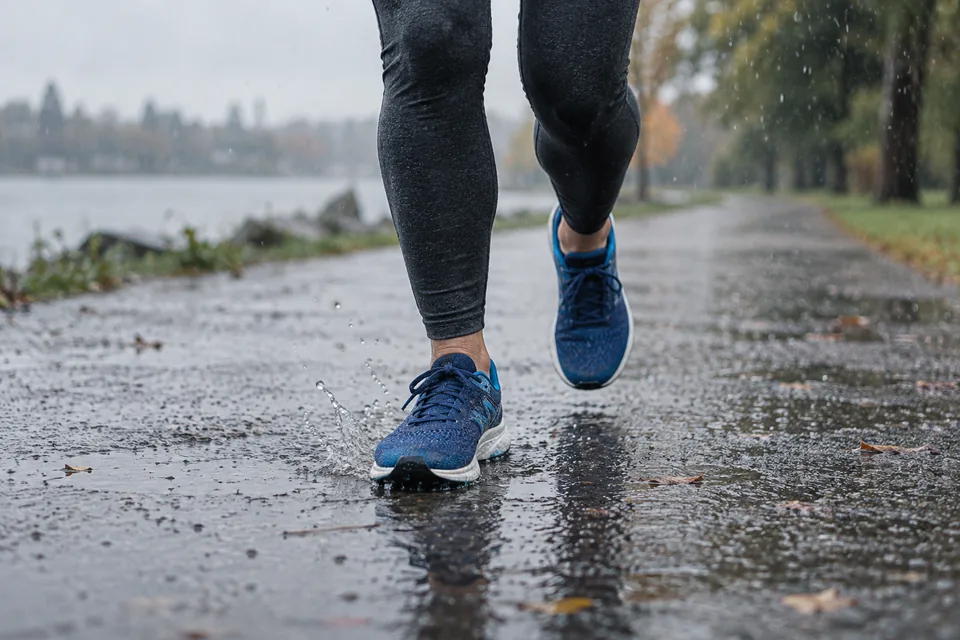
Running in rain starts with two questions: what kind of rain is forecast, and how cold or exposed will the route be? A warm shower on a short loop needs a different plan from cold rain on a long route. Check storms and footing before thinking about a jacket.
Rain chance is not rain intensity
A daily rain icon is too broad for planning a specific run. Read the probability, the period it covers and the expected amount when your forecast provides one. A high probability can describe a light shower; a lower probability can still leave a meaningful chance of getting wet.
The National Weather Service's precipitation-probability explanation describes a chance of measurable precipitation at a location during a forecast period. It does not express the fraction of your run spent in rain. Different providers may use different definitions, so avoid reading a probability as an exact promise about timing or amount.
Keep three forecast labels separate:
- Chance: a 70% probability is a chance for the stated place and period. It does not mean rain for 70% of your run.
- Amount: a hypothetical 0.08 in / 2 mm for one hour is an accumulation for that hour. It does not establish that rain will fall steadily for sixty minutes.
- Period or rate: a daily total covers a different window from an hourly total. A rate labelled mm/h or in/h describes rainfall intensity per hour; it is not interchangeable with an amount for an unspecified period.
The Met Office's forecast guide explains why the forecast period matters and why the same amount can fall across that period or in a short burst. Read your provider's labels rather than assuming every time-stamped value covers the same interval. Neither probability nor accumulation identifies an exact dry minute for your route.
Compare several hours around your preferred start. If there is a clearer window that still fits your schedule, use it. If the forecast remains changeable, choose a route with a quick return rather than assuming the driest-looking icon will be correct.
Choose clothing for wet conditions
Temperature still matters. At 60°F / 16°C, your usual light top and shorts may be a more comfortable starting point than a heavy shell, depending on wind and duration. At 45°F / 7°C, wet clothing and exposure make outer protection and a short route more relevant. These are outfit examples, not safe-running thresholds.
Think about what happens when you stop. If the run ends with an outdoor wait, arrange dry clothes or an indoor finish. The CDC notes that wet conditions can contribute to hypothermia, including at temperatures that do not seem extremely cold.
Use clothing and socks you have already tested. A rainy long run is a poor moment to discover an unfamiliar garment rubs when wet. Keep a small adjustment plan: open the shell if you become too warm, shorten the route if you become cold, and avoid carrying a layer that you cannot conveniently store or wear.
Thunder changes the decision
Rain itself and a thunderstorm are different hazards. If you hear thunder, seek shelter immediately. NWS sports guidance identifies a substantial building with wiring or plumbing as suitable shelter, or an enclosed hard-topped metal vehicle with the windows shut if a building is unavailable. Trees, sheds and open rain shelters are not suitable lightning shelter.
Wait at least 30 minutes after the last thunder before returning outdoors. That wait starts from the last thunder, rather than from when the rain stops. Identify a practical shelter option before leaving; a route with no reachable shelter may call for changing the session before a storm arrives.
Look for warnings before departure, but remember that an hourly score cannot guarantee that a storm will miss your route. A high score is not a reason to ignore thunder or an official warning. Changing to an indoor session is a useful plan, not a failed run.
Keep water and footing in view
Do not use a normal training route to justify crossing floodwater. Depth, current and the surface underneath can be difficult to judge. NWS flood guidance recommends turning away from flooded areas.
On ordinary wet routes, check the surfaces you actually encounter. Slow down or change the route when traction is uncertain. If temperatures are near freezing, assess ice separately; a rain forecast alone does not resolve surface conditions. The snow and refreezing guide explains why a dry hour or warmer air does not confirm that a path is clear.
Before leaving, check the start hour, finishing hour, nearest shelter and quickest return. Try the Seattle forecast or Manchester forecast, then adjust to your route. Use the clothing guide to choose a starting outfit, and keep the final decision tied to actual conditions.
WeatherToRun for iPhone
Compare hourly running scores, find a better time, and get clothing suggestions on your iPhone. Core forecasts and gear guidance are free. Extra planning and widgets are available with Plus.
Free to download. No account or ads.