Running in the dark: visibility, routes and weather
Check the route, your lighting and visibility, then compare daylight and weather through the end of your run.
By WeatherToRun, updated
Get hourly running scores and clothing suggestions on iPhone. Free core guidance. No account needed.
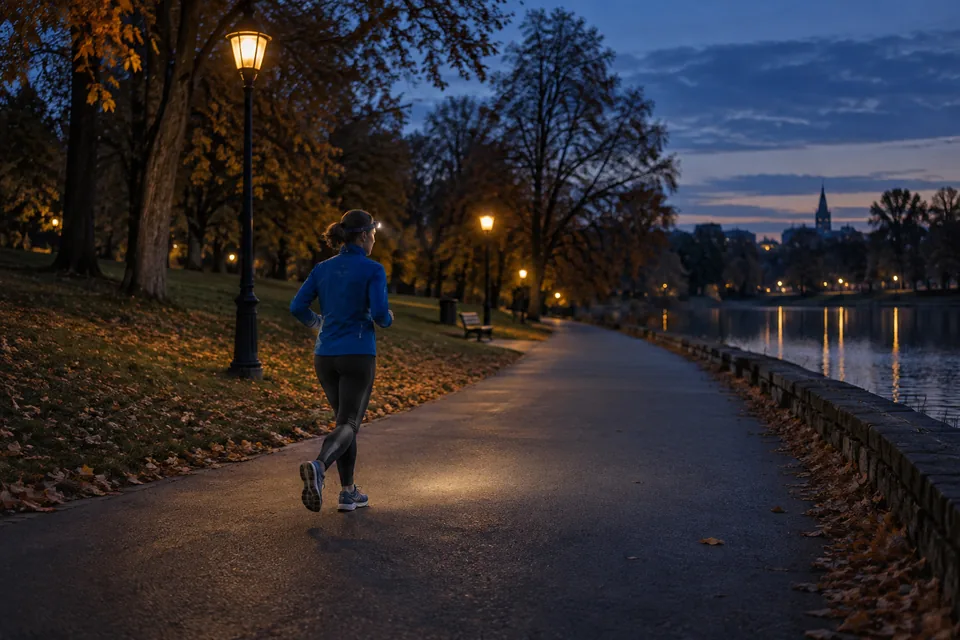
Running in the dark means planning for the surface you need to see and the road users who need to see you. A familiar route, working lighting and visible clothing are useful starting points. Check the light and weather through the end of the session before choosing your start time.
Check the light through the finish
A run can begin in daylight and finish with much less of it. In an illustrative example, a 45-minute session starting 20 minutes before sunset ends 25 minutes after sunset. Plan for the return leg as well as the first few minutes outside.
Sunset does not bring instant darkness. The National Weather Service explains twilight as partial natural light before sunrise and after sunset. Evening civil twilight begins at sunset and ends when the Sun's centre reaches six degrees below the horizon. That definition does not give every location a fixed number of usable minutes.
The US Naval Observatory's explanation also notes that clouds, atmospheric conditions and the visible horizon affect the light you experience. Trees, buildings and the route itself add local considerations. Use local solar times as planning information, then inspect the actual conditions. Carry suitable lighting when the outing could extend into poor light rather than assuming a sunset time describes every part of the path.
Prepare to see and be seen
Start with the ground ahead. A headlamp lets you keep your hands free, and the National Park Service's Ten Essentials recommends one alongside spare batteries for outdoor trips. For a run, test the lamp's fit, charge and beam before leaving. Make sure its runtime suits the whole outing, and consider a suitable backup for a route where losing the light would leave you isolated. If you cannot see where you are about to step, slow down or change the plan.
Visibility to other people needs its own check. The UK Highway Code's pedestrian guidance, Rule 3, distinguishes bright or fluorescent material in poor daylight from reflective material in darkness. Bright fabric alone does not replace reflective material after dark. Keep reflective areas exposed when adding a jacket or bag, and consider the directions from which traffic may approach.
A headlamp helps illuminate your path, but it does not ensure that someone approaching from behind can see you. Reflective clothing also cannot guarantee that a driver has noticed you. Continue checking traffic and the surface, even on a route with street lights.
Choose a route you can change
For an ordinary run after dark, a route you have already inspected in daylight is a useful starting point. Look for continuous pavements or sidewalks, appropriate paths, clear crossings and places where you can shorten the session. A known loop can make returning early easier than a long outward leg.
NHTSA's pedestrian safety advice recommends using sidewalks and crossing places, staying alert, and checking for turning or reversing vehicles. At a crossing, pause and check the traffic rather than assuming your clothing or the right of way means a driver will stop. Follow the local crossing rules for the place you are running.
Check opening hours, closures and access with the route's managing authority. A path shown on a map may be closed or unlit when you arrive. The National Park Service's trip-planning guide recommends checking current conditions and preparing an alternative. For a more isolated outing, sharing your route and expected return with a trusted contact is another useful part of the plan. Choose a route that also fits your own comfort and communication needs.
Read the weather behind the score
Darkness does not remove the other forecast checks. Compare feels-like temperature, rain and gusts through the finish, then look at the footing you actually find. In another illustrative example, a start at 52°F / 11°C and a finish at 45°F / 7°C may call for different layers. Those temperatures alone cannot tell you whether a particular outfit, pace or route will work.
Use the cold-weather guide for layers and wind chill, the rain guide for wet conditions, and the wind guide for gusts and exposure. Check official alerts for the location and time. In the UK, the Met Office's warning guide explains why the expected impacts and advice matter alongside the warning colour.
WeatherToRun's hourly score compares weather inputs; it does not assess street lighting, traffic or the condition of your path. A night hour can score well while a particular route remains unsuitable. Clothing suggestions can prompt a reflective-gear check, but they cannot confirm visibility. Compare the forecast, then make those local decisions separately.
Use a quick departure check
Before running in the dark:
- Set the whole window. Check the location, start, expected finish and changing light. Use the best-time-to-run guide to compare realistic options.
- Check lighting and clothing. Test the lamp and battery, keep reflective material visible, and choose layers for the forecast through the finish.
- Confirm the route. Check access, crossings, current conditions and a way to return early.
- Choose an alternative. A shorter lit route, a daylight slot or an indoor session may fit better if the light, weather or footing is unsuitable.
- Look again before leaving. Adjust to what you find outside rather than committing to the earlier plan.
Explore the London forecast or New York forecast, or get WeatherToRun for iPhone to compare hourly weather and clothing suggestions. Choose a workable forecast window, then match it to a route and lighting you have checked yourself.
WeatherToRun for iPhone
Compare hourly running scores, find a better time, and get clothing suggestions on your iPhone. Core forecasts and gear guidance are free. Extra planning and widgets are available with Plus.
Free to download. No account or ads.