Race-day weather: plan from start to finish
Check the whole window around your own wave, then make separate plans for waiting, racing and getting to dry clothes.
By WeatherToRun, updated
Get hourly running scores and clothing suggestions on iPhone. Free core guidance. No account needed.
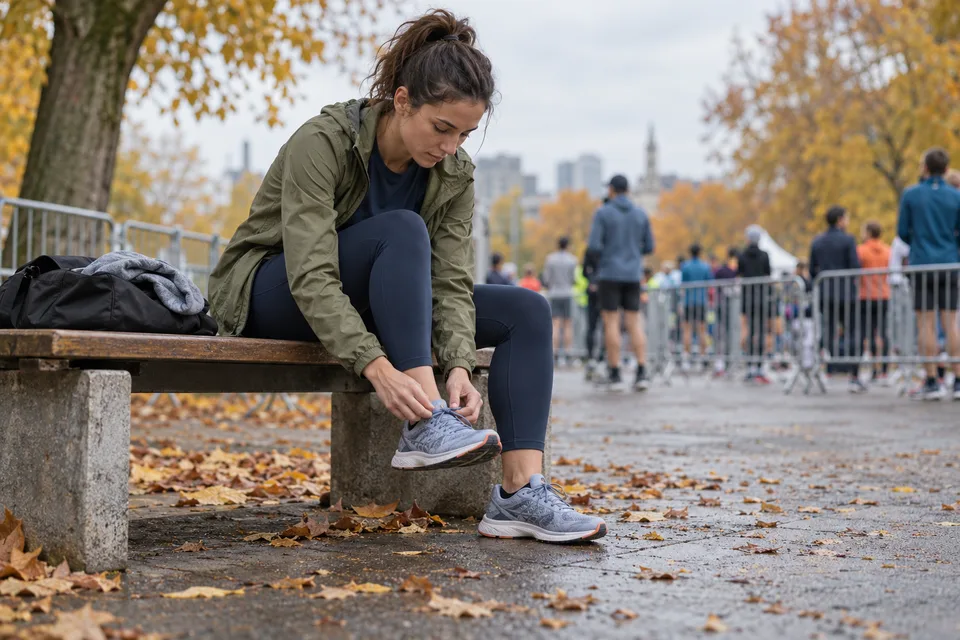
Race-day weather needs a longer view than the temperature beside the start time. A half marathon or marathon can include a chilly wait, a warming morning on the course and a wet walk after finishing. Build a plan for those separate parts of the day before deciding what to wear.
Unlike a training run, a race usually gives you a fixed window. You may be able to change your layers or your goals, but not move your wave to the nicest hour. The useful question is what conditions you could meet from arrival until you collect your belongings.
Build the forecast around your own wave
Write down four times in the event's local timezone: when you expect to be outside, your assigned start, a realistic finish range and when you expect to reach dry clothes or shelter. Use your own wave time rather than the first gun or the elite start. Check the current participant instructions for your assignment and travel arrangements.
For an illustrative half marathon, you might arrive at 7:30 a.m., start at 9 a.m. and finish between 11 and 11:30 a.m. Your weather window is longer than the two hours you hope to spend running. Add the likely walk and collection time after the finish, too.
A hypothetical forecast of 45°F / 7°C while waiting and 59°F / 15°C near the finish creates different clothing decisions. Those figures are examples, not a forecast or universal clothing thresholds. Separate the layer you want while standing still from the kit you have already found comfortable while running.
If travelling, confirm that the location, date and displayed timezone match the event. A familiar city name or your phone's home time can otherwise put the right forecast beside the wrong start.
Read the hours between start and finish
Compare the forecast through the whole window rather than stopping at the daily icon. The National Weather Service's hourly forecast guide shows how temperature, dew point, wind, gusts and precipitation information can be viewed together over time.
Focus on the changes that would alter your plan:
- Temperature and feels-like conditions: compare arrival, start, later course hours and the finish. Use the running clothing guide as a starting point, then adjust to familiar kit and your own experience.
- Rain: check the forecast period, probability, type and amount where available. The Met Office explains that rain probability differs from its intensity or duration. A percentage alone does not say how wet your entire race will be.
- Wind: read gusts as well as the average and consider the direction relative to exposed sections. The same Met Office guide distinguishes those fields; the wind-running guide helps turn them into route and effort considerations without promising a fixed pace penalty.
- Later warmth or mugginess: check temperature alongside dew point. The humidity guide explains why a relative-humidity percentage alone is incomplete.
For example, a 10 a.m. start and an estimated four-and-a-half-hour marathon means looking through 2:30 p.m. and beyond. A hypothetical rise from 50°F / 10°C to 64°F / 18°C, with rain becoming more likely after 1 p.m., matters even if an earlier finisher would miss it. This is planning arithmetic, not a finish-time prediction.
For a point-to-point or exposed course, also inspect relevant start, finish and course-area forecasts. One selected city location is not a mile-by-mile forecast. The NWS explanation of precipitation probability ties the chance to a point and a stated period; nearby places can have different conditions. Read the definitions used by your chosen service.
Give waiting, racing and finishing separate kit plans
Pack for three jobs, with the event's rules beside you:
- Before the start: a removable layer and suitable rain protection if needed and permitted. Decide where each item will go before entering the corral.
- On the course: clothing and shoes you have tried during training, chosen after reviewing the full race window. Check how you will carry anything you keep.
- After finishing: a dry change and a practical way to reach it, plus the walk or journey onwards.
London Marathon Events' event-day advice highlights familiar kit, removable layers and the cool period spent travelling or waiting. Its finish advice also recommends changing into warm, dry clothes. These are reasons to plan separate stages, not to wear every layer for the whole race.
Bag transport, allowed covers and clothing donation arrangements vary by event and edition. Do not assume an item left at the start will be waiting at the finish. Read the current gear-check instructions and use designated collection or donation points; keep discarded items away from runners' feet.
For more detail, use the rain guide or cold-weather guide. Keep the race-day decision focused on when you need each item and where it will go.
Recheck when the information can change your plan
Several days out, identify plausible scenarios and pack useful options. The day before, choose the likely kit and a backup. On race morning, check the updated forecast, official weather warnings, travel information and organizer messages before leaving. This is a suggested planning routine, not a guarantee about forecast accuracy.
The Met Office's forecast guide explains why local detail becomes harder to predict further ahead. Even a shorter-range forecast cannot pinpoint every shower. Treat a longer-range outlook as preparation information and make room to adjust as the event approaches.
Refresh with a decision in mind: whether to bring a waiting layer, protect a dry change or revise expectations for later conditions. Constantly switching between apps does not resolve uncertainty. Note when a forecast was updated and the period it describes before comparing it with another service.
In WeatherToRun for iPhone, you can save a start time, location and optional estimated duration, then compare the available hourly weather and gear guidance across that run. Check again when the date is within the available forecast range. The app does not track weather along every mile of a race course or replace the organizer's alerts.
Keep official instructions in your race plan
Find out where the event publishes changes and how it communicates conditions on the day. For example, the Chicago Marathon's safety guidance describes updates through official messages, announcements, signs and its Event Alert System. Other races may use different channels; learn the system for your own event.
A personal weather score cannot override a cancellation, course change or instruction from race officials. Check local weather warnings separately, remain alert to actual conditions and follow event directions if the plan needs to change. If you need help, contact the event's designated support or medical staff.
Before setting off, keep three decisions clear:
- Your whole window: arrival, assigned wave, expected finish range and journey to shelter or dry clothes.
- Your kit at each stage: what you will wear, carry, check or place in an approved donation point.
- Your update plan: where you will check the forecast and official instructions again.
Try the New York hourly forecast or London hourly forecast, then plan the available hours in WeatherToRun. Prepare for the day you expect, with a workable option for the changes you might meet.
WeatherToRun for iPhone
Compare hourly running scores, find a better time, and get clothing suggestions on your iPhone. Core forecasts and gear guidance are free. Extra planning and widgets are available with Plus.
Free to download. No account or ads.